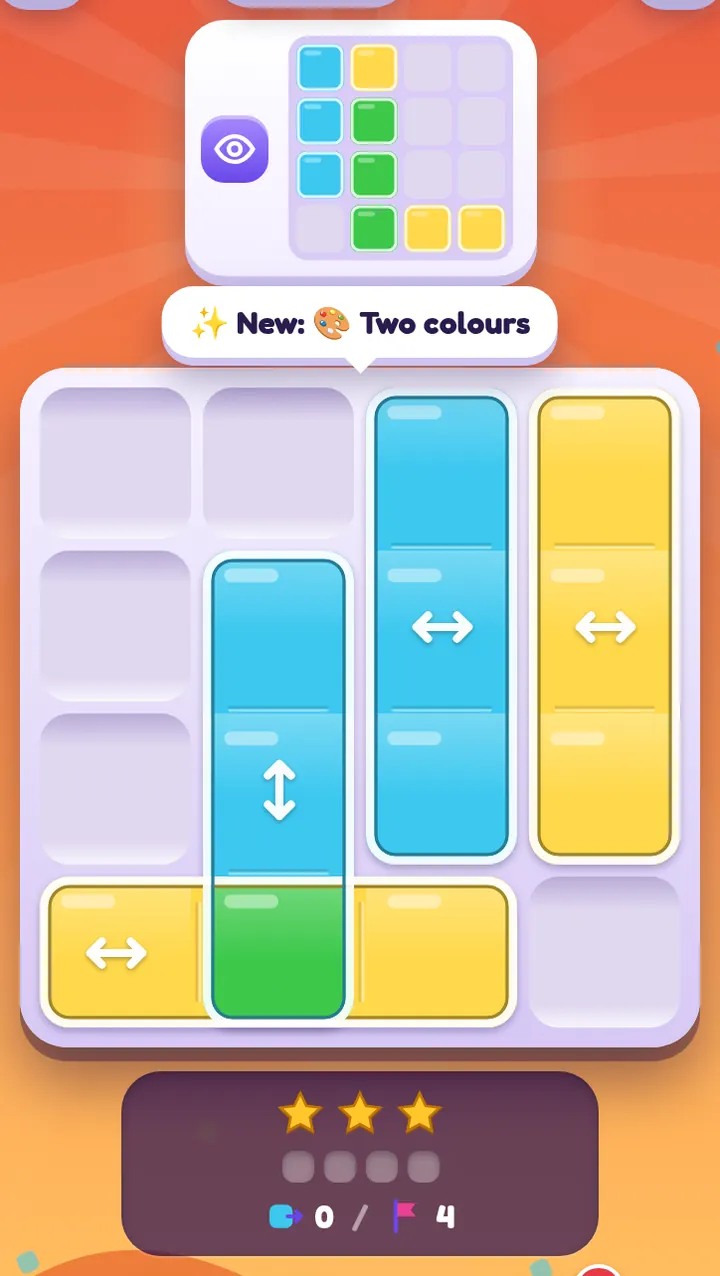
At level 18, PaneSlide introduces two-colour puzzles. The board and the picture use only two of the three glass colours: cyan and magenta, cyan and yellow, or magenta and yellow. The rules don't change at all. What changes is how you have to read the picture.
Why fewer colours can be trickier
With three colours, each mix tells you a lot. A green cell can only be cyan plus yellow, and black can only be all three. With two colours there is only one possible mix:
- cyan + magenta → blue
- cyan + yellow → green
- magenta + yellow → red
So the picture has just three kinds of filled cell: colour A, colour B, and their mix. On top of that, the board usually has more panes of the same colour. That means a magenta cell could be covered by any of several magenta panes, and you have to work out which.
Strategy for two-colour boards
1. Find the mixes first
Mixed cells are still your anchors. Each one needs one ↔ pane and one ↕ pane, one of each colour. Match each mixed cell to the panes whose rails pass through it. With several same-colour panes, there may be two or three candidates; write them down in your head.
2. Use rails to separate same-colour panes
Two panes of the same colour on the same kind of rail can never overlap, and they cannot pass each other along a shared line. If two ↔ magenta bars share a row, their left-right order is fixed for the whole puzzle. That order often tells you which one covers which magenta cells.
3. Count cells
Add up the cells of each pane of colour A. Then count the cells in the picture that contain colour A (plain A plus the mixes). The totals match exactly, because every pane is somewhere on the board at the end. If one pane is a long bar and the picture has a long run of colour A on one row, that run is almost certainly the bar.
4. Watch empty cells
Empty cells in the picture are firm "no glass here" rules. On two-colour boards with many same-colour panes, they are often the quickest way to rule out a position.
Tip. On a two-colour board, try naming the panes in your head: "top cyan", "bottom cyan". It is surprisingly easy to swipe the wrong one of two identical-looking panes.
Two-colour levels and stars
Two-colour teach levels are designed a little easier than their neighbours, with par one lower, so you can get used to the idea. After that they appear throughout Levels mode, sometimes combined with one other special kind. Stars follow the usual par rules: three stars for par or par + 1.
A note on colour vision
If two of the glass colours look similar to you, two-colour levels can be harder than they need to be. Switch on Patterns in Settings. Each glass colour then gets its own texture on the board and in the picture, so you can tell panes and mixes apart by pattern as well as colour. The setting is remembered on your device.
Why we added two-colour pictures
Early players told us the first chapters started to feel the same. Two-colour pictures change how a board feels without adding any new rule: the panes, glide and stick all work exactly as before. It is a gentle way to make you look at the picture with fresh eyes, before the bigger changes like stone pillars and ice arrive.
Play from level 18 on the level map, and see the colour mixing guide if you want the science behind the mixes.