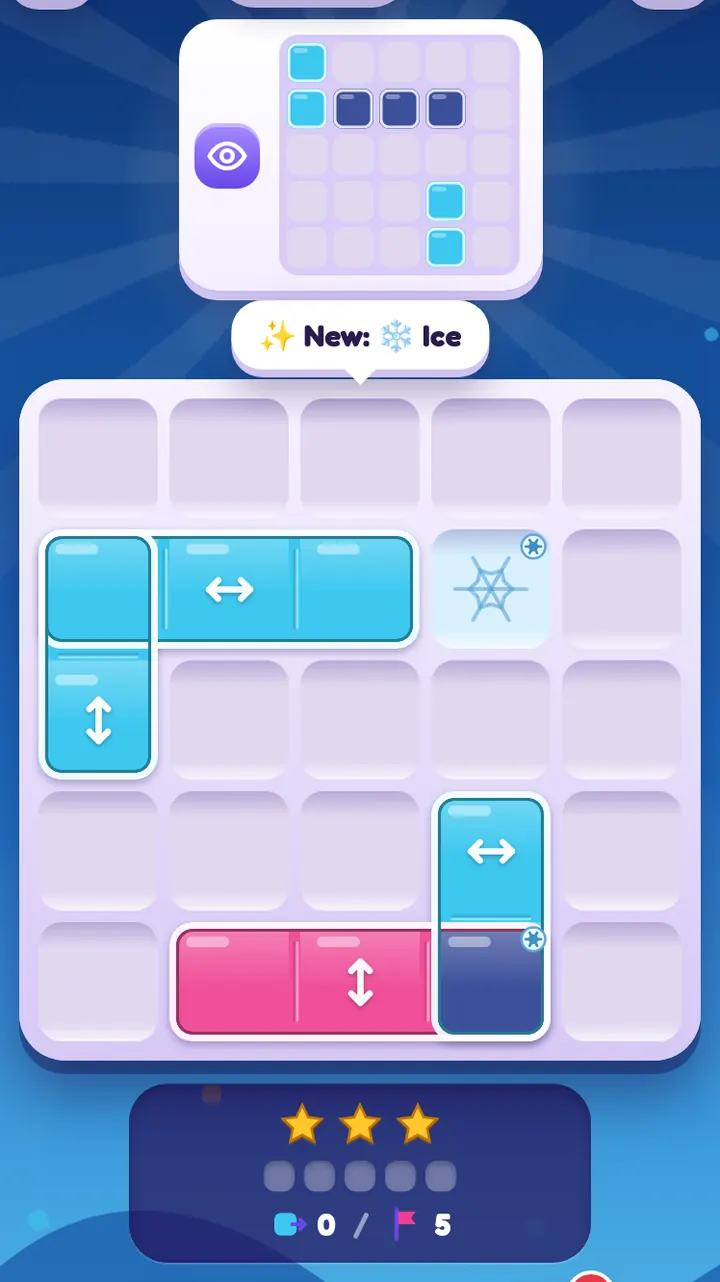
At level 42, pale blue cells with a snowflake start to appear on the board. These are ice cells. They change one rule: on ice, glass does not stick.
The rule, exactly
Normally, a gliding pane sticks the moment it slides onto new colour, meaning a step that makes its overlap with crossing glass bigger (see glide and stick).
On ice, overlaps don't count. When the game measures a pane's overlap with crossing glass, it ignores any overlapping cells that are on ice. So if a pane slides onto crossing glass on an ice cell, its overlap count does not go up, it does not stick, and it keeps gliding.
Everything else is unchanged:
- Panes still stop at the edge, before stone pillars, and before glass on the same kind of rail.
- Glass can still rest on ice and still mixes colours there. Ice only affects sticking, not what you see.
- Overlaps on normal cells still count. A pane that crosses glass on ice and then meets crossing glass on a normal cell will stick there.
What ice does to a puzzle
Ice removes stopping points. A crossing pane that would have been a perfect stopper does nothing if the crossing happens on ice. That makes some slides much longer, and it means some positions that look easy to reach are not reachable in one swipe.
It also makes some panes easier to place. If a pane needs to pass over other glass to reach the far edge or a pillar, an ice cell under that crossing lets it slide straight through.
The level maker places ice on cells where crossings happen, so ice always matters to the solution. It is never just decoration.
How to plan with ice
- Find the ice cells (snowflake badges) and mark which rails pass through them.
- For each crossing on ice, cross it off as a stopper. A pane will glide straight across it.
- Look for the next stop beyond the ice. That could be the edge, a pillar, a same-rail pane, or the next crossing on a normal cell.
- Use ice to your advantage. Sometimes the shortest solution relies on a long glide across ice to reach a corner in one swipe.
Tip. If a pane keeps "overshooting" its target, check whether the stopper you wanted is sitting on ice. You may need a different stopper, or to move the pane from the other side.
Ice vs sand
Ten levels later, at level 52, you meet sand, which does almost the opposite: sand adds a new way for glass to stop. Some later levels use both, and the contrast between them is a big part of the fun.
| Ice ❄️ | Sand 🏖️ | |
|---|---|---|
| Effect | crossings on ice don't make glass stick | glass stops when it slides onto more sand |
| Slides become | longer | shorter |
| Good for | reaching far edges | stopping mid-board |
Ice in later chapters
After level 42, ice comes back in every chapter. Each chapter of 20 levels features the special kinds you have seen least recently, and brings the rest back at least once, so you will meet ice again before you can forget how it works.
A small physics note
Real ice is slippery because a thin layer at its surface behaves like a liquid and reduces friction. Scientists still debate exactly why that layer forms. PaneSlide's ice is much simpler: it is just a rule that switches off sticking. But it does make glass feel slippery, which is the point.
Play from level 42 on the level map.