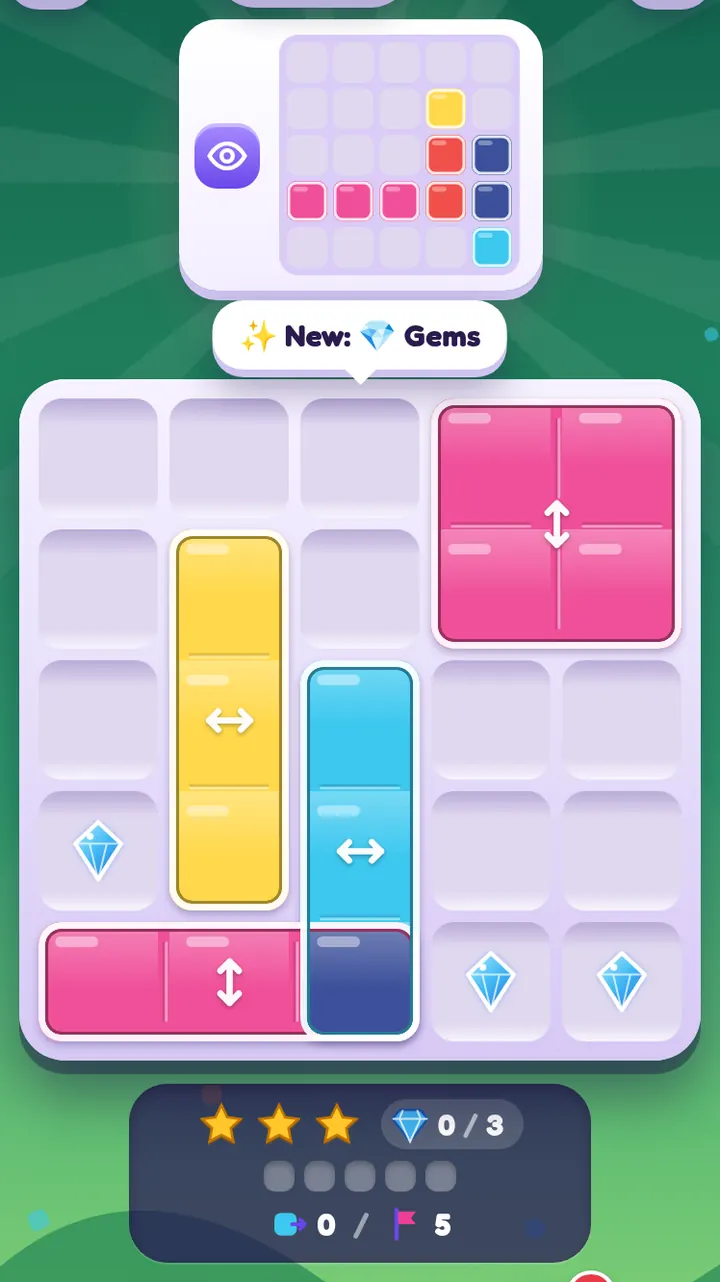
At level 33, small sparkling diamonds appear on some cells of the board. These are gems. They don't change how glass moves at all. They are a bonus: slide any pane over a gem and you collect it.
The rules
- A gem is collected when any pane passes over it or lands on it during a swipe. It does not matter which pane or which colour.
- Each gem you collect is worth 1 shard.
- A gem counter under the board shows how many you have and how many there are.
- Gems never block, stick or stop glass. The glide and stick rules work exactly as they would without them.
- Gems appear in Levels mode only, not in the daily puzzle.
Where gems are placed
Gems are not scattered at random. When a gem level is made, the game finds the shortest solution and places gems on cells that the panes pass over on that route. The level checker confirms that every gem can be collected while still solving in par.
That gives you a useful clue: gems point along the best route. If a gem sits in the middle of an empty row, some pane in the perfect solution glides through that row.
How to collect every gem
- Plan the solution first. Read the picture and work out where each pane must end, as in plan your swipes.
- Use the gems as a check. For each gem, ask which pane could pass over it on the way to its target. If none can on your plan, your plan may not be the shortest one.
- Pay attention to direction. A pane that reaches its target by gliding from the left passes different cells from one that arrives from the right. Gems often tell you which direction is right.
- Don't chase gems with extra swipes unless you don't mind losing a perfect solve. One extra move to grab a missed gem is fine for three stars (par + 1), but not for ✨ Perfect.
Tip. If you solved a gem level but missed a gem, replay it. Knowing the answer, try to find the route that sweeps every gem. It is a good way to see the shortest solution.
A worked example
Picture a row with two gems in the middle and a cyan pane at the left end. The target needs that cyan pane at the right edge. One swipe right sends it gliding all the way across, over both gems, and collects them both on the way. Now imagine the target needed the pane in the middle instead. A crossing pane would have to be moved into its path first so it sticks there, and the gems that lie beyond that point would belong to some other pane's route. Reading gems this way, as "which pane passes here?", often reveals the order of the swipes before you make a single one.
Gems and your records
Collected gems add to a lifetime gem total shown in your records. There are two badges for gems: Gem hunter for 25 gems and Treasure keeper for 100. Each badge also gives 10 shards.
What shards are for
Shards buy useful and fun things in the shop: an extra hint, new board styles and different music moods. They can only be earned by playing, never bought with money. See par, stars and perfect solves for every way to earn them.
Gems in later chapters
After level 33, gem levels return throughout Levels mode, sometimes together with one other special kind like stone pillars or ice. Combined levels are where gems are most helpful, because they quietly point at the route through a busier board.
Play from level 33 on the level map and see how many you can collect in par.